Mastering Forex Correlations: How AI is Revolutionizing Multidimensional Trading
May 1, 2026Mastering Forex Correlations: How AI is Revolutionizing Multidimensional Trading
If you trade the financial markets, you know that assets rarely move in isolation. When one currency pair shifts, it often creates a ripple effect across the board. Understanding these interconnected movements is crucial for any trader looking to maintain a profitable edge. These connected movements are known as forex correlations and mastering them can completely transform how you approach the market.
Tracking these moves manually is incredibly difficult. Markets move fast, and human brains can only process so much information at once. That is exactly where artificial intelligence steps in. By leveraging advanced AI systems, traders can finally decipher the complex web of market movements. Let us explore how multidimensional analysis and evolutionary AI learning can help you capitalize on forex correlations and build a stronger, more adaptive trading strategy. Check out the video further down this article to see firsthand some real trades that were in correlation.
What Are Forex Correlations?
Forex correlations measure how two or more currency pairs move in relation to one another. When two pairs move in the exact same direction, they have a positive correlation. When they move in opposite directions, they have a negative correlation.
For example, when the Euro to US Dollar (EUR/USD) pair moves down, the British Pound to US Dollar (GBP/USD) pair often follows a very similar downward path. The price of Gold is also heavily tied to the US Dollar, meaning it frequently mirrors these currency movements.
Understanding forex correlations is vital because it helps traders manage risk and spot overlapping opportunities. If you go long on two highly positively correlated pairs, you are essentially doubling your risk. Conversely, if you recognize a correlated move early, you can confirm market trends and find multiple profitable entry points. The challenge lies in timing. Even if two assets correlate, they rarely move at the exact same millisecond. This slight delay requires a highly sophisticated, multidimensional approach to catching the trade at the perfect moment.
The Power of Multidimensional Analysis
To truly take advantage of forex correlations, you need more than just a simple chart. You need multidimensional analysis. This involves looking at a specific asset across several different timeframes simultaneously to find confluence. Confluence happens when multiple indicators or timeframes align, signaling a strong probability that a move is about to happen.
Advanced AI trading systems like xBratAI use what we call an anchor timeframe. The anchor timeframe serves as the foundation for the trade, while lower and higher timeframes feed into the system to build confluence.
Consider a recent short trade on the cryptocurrency XRP. The AI selected a 25-minute anchor timeframe. By analyzing the data through a multidimensional lens, the system watched confluence build up across various timeframes. The moment the vertical lines of data aligned perfectly, the AI triggered a short entry. It then sent push notifications to users, advising them to adjust their stops as the trade progressed into profit. Keeping the data set live and current, by always tracking the most recent 20 trades, allows the system to maintain accurate win rates, which sat at a solid 65% for XRP with an average trade time of just under nine hours.
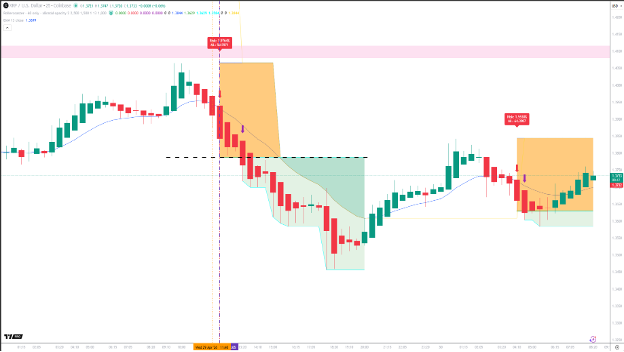
While this multidimensional approach works wonders for crypto, it becomes even more powerful when applied to the vast, interconnected world of forex correlations.
Real-World Examples: EUR/USD, GBP/USD, and Gold
To see how AI handles forex correlations in real time, we can look at a recent sequence of trades across the Euro, the British Pound, and Gold. In the space of just six hours, the xBratAI system executed four trades with an impressive 75% overall win rate. Here is a breakdown of how it handled the correlated moves
The system identified a strong downward move for the EUR/USD pair. For this specific trade, the AI selected an 8-minute anchor timeframe.
Because the AI found the perfect groove between the anchor timeframe and the corresponding timeframes, the confluence built up flawlessly. Around 1:32 AM UTC, the multidimensional view aligned perfectly. The system sent out the order and push notification to go short. The trade was managed exceptionally well from entry to exit, resulting in a clean win. Currently, the system holds an 80% win rate for EUR/USD, proving the effectiveness of this tight 8-minute anchor strategy.
The Late but Profitable Entry: GBP/USD
Because of established forex correlations, we know that when the EUR/USD goes down, the GBP/USD invariably drops as well. The move down against the US Dollar was happening, but the AI handled this second pair slightly differently.
For the GBP/USD trade, the AI selected a 14-minute anchor timeframe. The other timeframes leading into the correlation were lower, but the 14-minute mark acted as the anchor. Because the system used a longer anchor timeframe, the entry came in a bit later into the move compared to the Euro. Even though the broader move started around 1:00 AM, the system entered the GBP/USD short a bit later in the cycle.
Despite the delayed entry, the trade was still a winner. However, because the system got in later, it did not extract as much profit from the downward move as it could have. The GBP/USD currently maintains a 70% win rate with a perfectly balanced 50-50 split between long and short trades. This profitable but slightly delayed trade provides vital data for the AI to learn from.
The Cost of a Missed Timeframe: Gold
This brings us to Gold. The established forex correlations dictate that if EUR/USD and GBP/USD move down, the correlated move on Gold is also down.
The downward move happened exactly as expected. However, for Gold, the AI had settled on a 20-minute anchor timeframe strategy. We went from a highly responsive 8-minute anchor on the Euro to a 20-minute anchor on Gold. In the fast-paced trading environment, that percentage difference in time is massive.
Because the anchor timeframe was too wide, the entry came in much too late, around 4:00 AM. By the time the system established confluence and executed the trade, the bulk of the downward move had already passed. As a result, this specific Gold trade was a loser and stopped out.
Despite this single loss, the overall system remains highly balanced, maintaining a stellar 90% win-rate on Gold trades. More importantly, this loss serves a crucial purpose in the grand scheme of automated trading.
Evolutionary Learning: How AI Adapts to the Market
The only way an Artificial Intelligence system can truly evolve is if it sometimes gets things wrong. When a trade fails, it is not a complete loss; it is a data point.
Markets go through periods of intense choppiness. Global events, geopolitical news, and shifting economic data can temporarily throw normal forex correlations out of sync. When the market behaves unpredictably, the AI must widen its parameters to make sense of the chaos, which is why we saw the anchor timeframes stretch from 8 minutes to 20 minutes.
However, once the choppiness subsides and normal market conditions return, the correlations get back in tune. The evolutionary learning aspect of the AI kicks in during its weekend recalculations. The system reviews the trades, recognizes that entering a correlated move on a 20-minute anchor timeframe was too slow, and adjusts.
For the following week, the AI will learn from that specific Gold loss. It will understand that the forex correlations are back in a normal groove. Consequently, it will adapt by selecting better, tighter timeframes for correlated moves. Instead of having anchor strategies spread far apart, we can expect the timeframes for correlated forex pairs, futures, and crypto to come much closer together. This continuous loop of execution, evaluation, and adaptation is something a human being simply cannot do manually. Attempting to decipher these combinations for confluence across multiple dimensions is beyond human capacity, but it is exactly what AI is built to do.
Why You Need AI to Trade Forex Correlations
Relying on a single chart or a basic indicator is no longer enough. The financial markets operate in multiple dimensions, and your trading strategy must do the same.
By tracking forex correlations through an AI-driven, multidimensional lens, you gain a massive advantage. You remove the emotion from your trading. You stop guessing when confluence is building and start relying on hard, mathematically calculated probabilities.
Even when the AI misses a step, such as entering a Gold trade too late, it immediately uses that failure to strengthen its algorithms for the next week. It constantly balances itself, adapts to choppy markets, and readjusts its timeframes the moment assets fall back into their natural correlated rhythms. Four trades in six hours with a 75% win-rate is just a snapshot of what an evolving, self-correcting system can achieve.
Take Your Trading to the Next Level
You no longer have to stare at multiple screens trying to connect the dots between the Euro, the Pound, and Gold. Let artificial intelligence handle the heavy lifting, analyze the multidimensional data, and alert you the moment true confluence builds.
If you want to trade smarter, capitalize on real-time forex correlations, and utilize a system that actually learns from the market every single week, it is time to upgrade your toolkit. Explore the power of automated, multidimensional analysis today.
Check out the xBratAI platform to see how advanced algorithms can transform your strategy. The app is fully available for download on both Android and Apple devices, and you can also access the powerful web app version from your desktop. Visit https://xbratai.com/ right now to get started and take control of your trading future.