Letting Runners Run in Futures Trading: Mastering the Psychology and Process
November 24, 2025Letting runners run in futures trading is one of the most sought-after skills for traders seeking long-term profitability. Day trading futures is a battlefield, but the fiercest opponent is rarely the market itself. It’s the one staring back from the screen's reflection. The battle is internal, a constant struggle between fear, greed, patience, and discipline. One of the most challenging psychological hurdles for any trader, new or seasoned, is letting runners run in futures trading when your instincts urge you to secure profits early. It sounds simple, but in the heat of the moment, with real money on the line, it is anything but.
Why is letting runners run in futures trading so difficult? It boils down to our innate human wiring. We are conditioned to avoid pain and seek pleasure. In trading, this translates to a powerful urge to cut losses quickly (avoiding pain) and an equally strong impulse to lock in profits quickly (seeking pleasure). While cutting losses is a cornerstone of responsible trading, prematurely taking small profits is the silent killer of long-term profitability. You end up with a strategy of "death by a thousand cuts," where many small wins are wiped out by a handful of expected losses.
The truth is, you will never know which trade has the potential to become a massive winner, a "runner", before it happens. The future is unwritten. No indicator, no chart pattern, no guru can tell you with certainty that this specific setup will be the one that breaks out and trends for hundreds of ticks. This uncertainty is where the psychological game of letting runners run in futures trading is won or lost.
A Real Example: Letting Runners Run in Futures Trading with XBratAI Push Notifications
To understand how discipline in letting runners run in futures trading is supported by technology, let’s focus on a recent Russell futures trade executed with the XBratAI app. The true power of XBratAI lies in more than just identifying high-quality signals, it revolutionizes trade management by automating crucial decisions and communicating them through instant push notifications.
In this instance, the app delivered a strong confluence of signals, generated from multiple non-correlated indicators:
What sets XBratAI apart for letting runners run in futures trading is its ongoing trade management. Once in the trade, the app automatically recalculated stop-loss levels as the market moved and sent push notifications each time a trailing stop should be adjusted, based on rules by it algorithms. This meant that at every stage, overnight, during volatile market sessions, and around key economic news, the app prompted the user with precise instructions, taking emotional second-guessing out of the equation.
No longer did the temptation to "lock in gains" override the plan, because each stop adjustment, each step for locking in profit, was dictated by the XBratAI app’s objective criteria and communicated instantly via mobile alert. As the trade developed, these notifications ensured the position was managed systematically, letting runners run in futures trading as far as possible. Even as the trade reached exceptional gains, 1,000 ticks, the disciplined exit was triggered by the latest push notification, not by anxious decision-making.
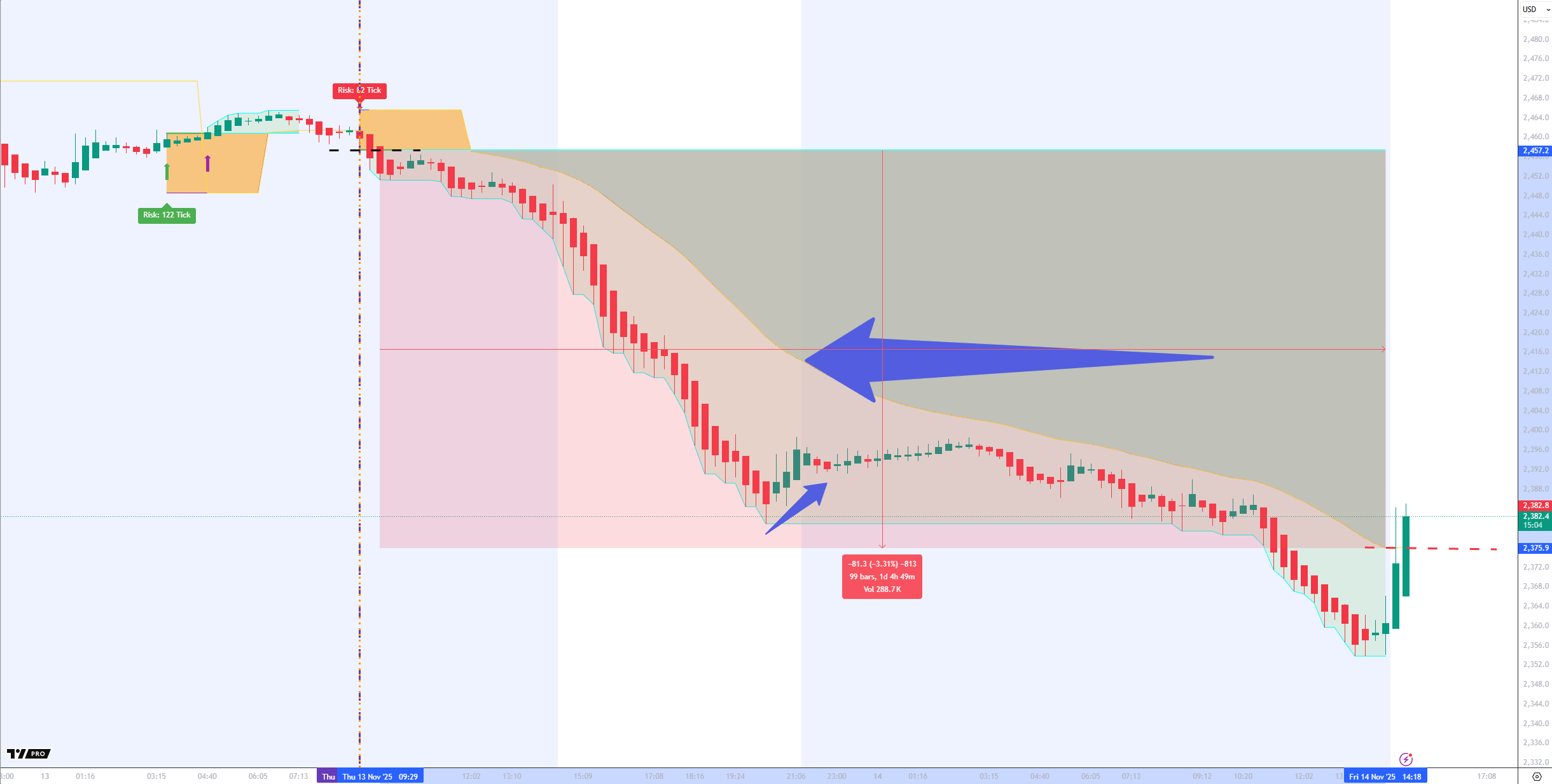
Even if a pullback had resulted in an earlier stop (capturing 454 ticks, for example), traders following XBratAI's push-notified instructions would have executed their plan perfectly, with full confidence and without regret. This kind of automation empowers traders to stay consistent, avoid emotion-driven errors, and reliably capture those rare, game-changing runners. And just as important: if the stop had been hit during a pullback for 436 ticks instead, that too would have been a win, because the plan was executed as intended. But as you can see from the chart image below, this pull back never came close the trailing stop. Panicking with price moved up against the direction of the trade in this case would have so much profit on the table.
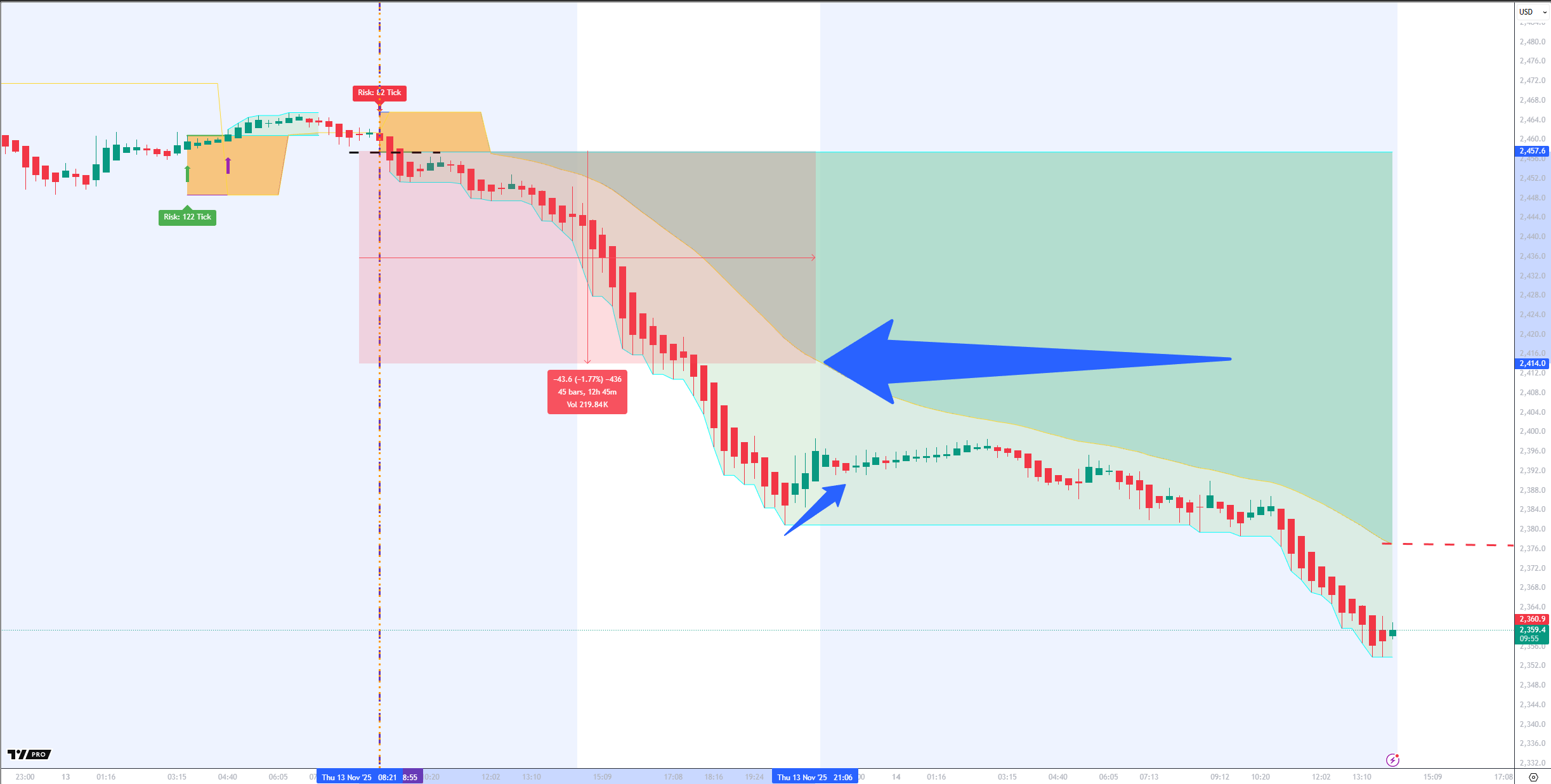
This is letting runners run in futures trading as it should be, without regret, anxiety, or the stress of trying to guess what the market will do next. Rather than chasing certainty, real traders trust their process and recognize that outliers, those runners, can only be caught by giving every trade an equal shot at success.
The Siren Song of Small Profits
Imagine this scenario: You enter a trade based on a solid confluence of signals. The market moves in your favor. Your profit and loss (P&L) statement turns from red to green. Ten ticks, twenty ticks, thirty ticks. Your heart starts to beat a little faster. The voice in your head begins its persuasive argument: "Take it. That's a good profit. You don't want to give it back. What if it reverses?"
This voice is driven by fear, the fear of a winning trade turning into a losing one. It’s a powerful emotion that makes locking in a small, guaranteed gain feel like the safest, most logical thing to do. You click the "close" button and feel a wave of relief. You banked a win. But a few minutes later, you watch in a mix of frustration and regret as the market continues to soar in your original direction, moving another hundred ticks without you. You captured a pebble from a potential avalanche of profit.
This cycle is incredibly common in futures trading. Traders become so focused on their win rate that they sacrifice the size of their wins. They’d rather have ten small wins than eight small losses and two massive wins, even if the latter scenario is far more profitable. The ego loves a high win rate, but your trading account loves large average wins, especially when you let runners run in futures trading.
Discipline: Your Only Shield Against Emotion in Letting Runners Run in Futures Trading
If we can't predict runners, how do we catch them? The answer lies in unwavering discipline and a mechanical trade management plan. Instead of trying to guess which trade will be the big one, you must treat every trade as if it could be the one. This means having the exact same management plan for every single entry that meets your criteria.
As shown in the Russell trade, statistical analysis of the xBrat confluence method shows that while many trades will average 400 ticks, approximately 20% of these setups have the potential to become significant runners. That's one in every five trades. You don't know which one it will be the first trade of the week or the last. Therefore, you must manage all five trades with the potential for a runner in mind, true discipline for letting runners run in futures trading. Just follow the trade management push notifications from the xBratAI App!
By following this plan on every single trade, you automate your decisions and remove emotion from the equation. You aren't guessing. You aren't hoping. You are executing a predefined plan identified as in the groove by xBratAI. Four out of five times, you might get stopped out at breakeven on the second half of your position. But on that fifth trade, the runner, you will be perfectly positioned to capture a move that can potentially pay for all your small losses and then some. This is how professional traders master letting runners run in futures trading.
Overcoming the Psychological Hurdles of Letting Runners Run in Futures Trading
Cultivating the discipline to let runners run in futures trading requires conscious effort and practice. It means fighting against your own instincts.
Challenge 1: The Fear of Giving Back Profits
After your trade is in the green, the unrealized P&L can feel like it's already yours. The thought of it shrinking is painful.
Solution: Reframe your thinking. It's not "your" money until the trade is closed. It is the market's money. Your job is to follow your plan, not to protect a fluctuating number on the screen. Moving your stop to breakeven is the mechanical solution to this fear, an essential tool for letting runners run in futures trading.
Challenge 2: Impatience and the Need for Action
Sitting still and doing nothing is one of the hardest things for a trader to do. We feel the need to be constantly managing, tweaking, and "helping" the trade along.
Solution: Once your trade is risk-free, walk away. Minimize your screen time. Set an alert for your trailing stop or final target and go do something else. Trust in your system. Micromanagement is a form of self-sabotage rooted in a lack of confidence in your plan. Letting runners run in futures trading depends on this trust.
Challenge 3: The "What If" Game
"What if it reverses right now?" "What if this is the top?" This internal chatter creates anxiety and leads to impulsive decisions.
Solution: Accept uncertainty. The "what if" game has no end. The market will do what it will do. The only variable you have absolute control over is your own actions. Stick to your plan. If you get stopped out, it's because your plan told you the trade was over, not because your fear got the best of you.
Actionable Steps to Succeed at Letting Runners Run in Futures Trading
Building this mental fortitude takes time. Here are some concrete steps to start today:
Define Your Plan in Writing: Have a crystal-clear, written trade management plan. Specify your entry, stop-loss, profit targets, and trailing stop strategy. If it’s not written down, it’s not a real plan.
Trade a Smaller Size: If you're struggling with the psychology, reduce your position size until the monetary value is no longer intimidating. This allows you to focus on flawless execution of the plan rather than the P&L swings, crucial for letting runners run in futures trading.
Review Your Trades: At the end of each day, review your trades. Look at the ones you cut short. Mark on the chart where your trailing stop would have taken you out. This visual evidence will reinforce the cost of impatience and the benefit of discipline, supporting your commitment to letting runners run in futures trading.
Embrace Breakeven Trades: Celebrate a trade that hits your first target and then stops you out at breakeven. This is not a failure. It's a perfect execution of a plan designed to catch runners. You successfully managed risk and gave the trade a chance to be great.
Ultimately, letting runners run in futures trading is not about being a brilliant predictor. It is about being a disciplined executor. Like in the Russell trade, where the only variable in your control is your ability to stick to the plan, discipline is rewarded by those rare runners that make all the difference. By having a consistent trade management approach for every setup, you position yourself to catch the inevitable runners that the market provides. Let go of the need to be right on every turn, and instead focus on being disciplined with every action. Trust your plan, manage your risk, and when you catch a winner, have the courage to keep letting runners run in futures trading. By the way! All runners come to a good end and this same RTY trade mentioned earlier eventually took out the trailing stop for over 800 ticks profit! Most traders reacting to that first pullback and getting out too early left another 400 ticks of profit on the table! As below on the chart.